Muzeum Ziemi

PAN MUZEUM ZIEMI W WARSZAWIE

Autor: Michał Kazubski

Visit us and discover the natural treasures of our planet!

Visit us and discover the natural treasures of our planet!

The Museum of the Earth gathers, studies, preserves and exhibits collections covering all the geological sciences, with special regard to Polish minerals, meteorites and rocks, Baltic amber, fossil flora and fauna and archival documents on the history of the Earth sciences in Poland. Its staff carries out scientific studies concerning these collections and popularizes the Earth sciences.

The museum’s collection comprises over 180,000 specimens and objects. Particularly noteworthy is its extensive collection of amber and other fossil resins, ranking among the largest natural science collections of such type worldwide. The museum’s interdisciplinary research programme and documentary work (i.e. palaeobotany, palaeozoology, mineralogy – especially amber studies, preservation of geological heritage, history of the Earth sciences and museology) is closely linked to the varied profile of specimen collections and is open to specialists from both domestic and foreign centres.

The Museum of the Earth organizes permanent, temporary and travelling exhibitions, which play a significant educational and public relations role.

Whiter than White

Whiter than White

November 17 – December 29, 2017

Andrzej Kalina – Artwork

Mikołaj Kalina – Photography


Opening hours:

Monday to Friday: 9 a.m. – 4 p.m.

Saturday: closed

Sunday: 10 a.m. – 4 p.m. (free admission)

Regular ticket: 5 PLN

Reduced ticket: 3 PLN


[Best_Wordpress_Gallery id=”27″ gal_title=”Bielszy odcień bieli”]

Monumental Erratic Boulders

Monumental Erratic Boulders

Exhibition of a group of huge erratic boulders is situated in front of the Museum. The largest of them has the diameter of 9.6 m and weights more than 35 tons. The boulders were recovered from glacial deposits during construction works in different parts of Warsaw. As geological documents of particular value, they are protected by the Museum of the Earth as monuments of inanimate nature.

Colourful World of Minerals

Colourful World of Minerals

The purpose of this exhibition is to explain the cause of forming colours that we see when looking at a particular stone, such as chemical composition, presence of inclusions or internal structure. Presented specimens have been arranged by colours and additionally divided into idiochromatic (deriving a characteristic colour from its capacity to absorb certain light rays), allochromatic (having no colour in itself but bearing coloured impurities) and pseudochromatic colours.

[Best_Wordpress_Gallery id=”22″ gal_title=”Barwny świat minerałów”]

Large Mammals of the Ice Age

Large Mammals of the Ice Age

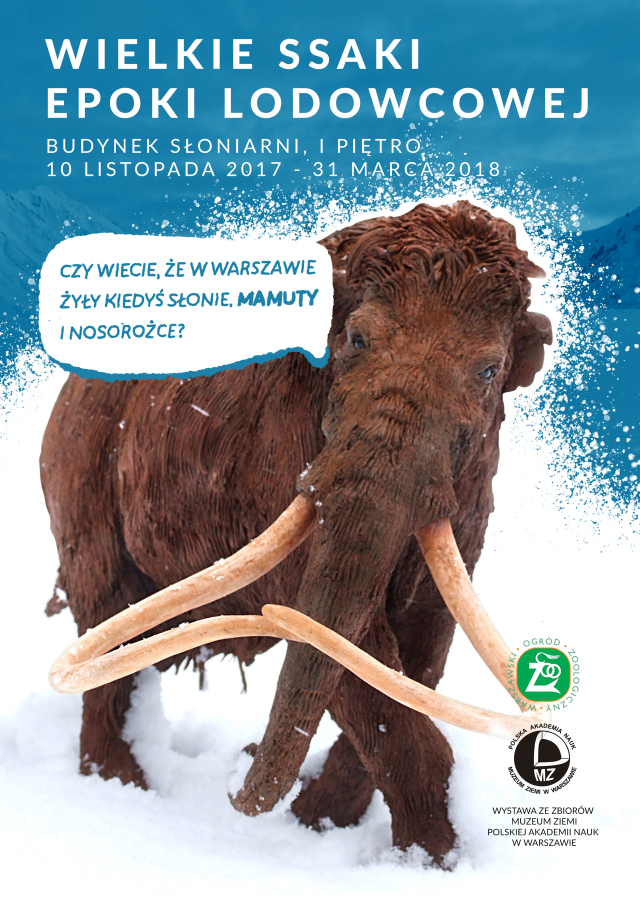
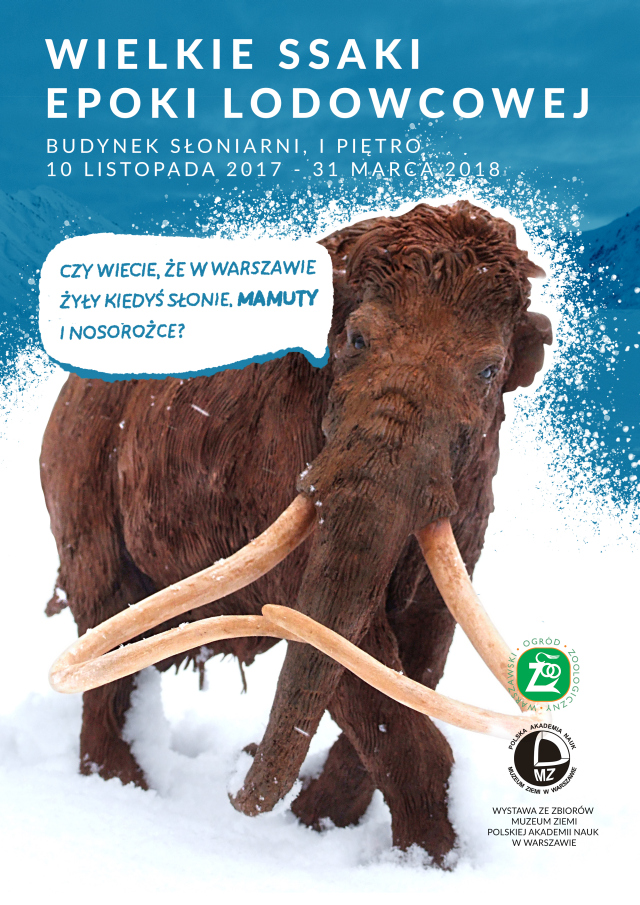
The exhibition is dedicated to large mammals that lived in the territory of Poland in the Quaternary, during the Pleistocene, often referred to as the Ice Age. This relatively short – in geological terms – period of around 2.5 million years was characterized by several violent cycles of climate warming and cooling in a global scale that had a direct impact on the expansion of the world of plants and animals. In the Pleistocene sediments many remains of plants and animals have been preserved and among them numerous large mammal bones that allow for reconstruction of these meaningful changes to the natural environment. The exhibition presents mammalian remains discovered in different parts of Poland (also in Warsaw) from glacial and interglacial periods. Remains of cryophilic animals typical for glacial periods presented in the exhibition include: mammoth skeleton (Mammuthus primigenius), woolly rhinoceros (Coelodonta antiquitatis) and steppe bison (Bison priscus). Thermophilic animals, typical for interglacial periods – warmer than modern times – are represented by: the remains of a straight-tusked elephant, one of the world’s largest Elephantidae species (Palaeoloxodon antiquus), the skull of forest rhinoceros (Dicerorhinus kirchbergensis) one of the four preserved in the world! as well as the skull and bones of an aurochs (Bos primigenius), which lasted until the historical times and the last one died out in 1627, about 40 kilometers west of Warsaw.

[Best_Wordpress_Gallery id=”23″ gal_title=”Wielkie ssaki epoki lodowcowej”]

The World of Plants and Climate Change

The World of Plants and Climate Change

Our small exhibition presents evidences for global climatic changes that Earth has experienced in the last 65 million years. Fossils all around the world indicate that between 58 – 50 million years ago (late Paleocene – early Eocene) the ocean and atmosphere temperature were much higher than today. This climate episode is known as the PETM –Paleocene/Eocene Thermal Maximum. We present fossil plant remains from that period. The visitors can observe such specimens as leaf impressions and fragment of wood from Eocene of Geiseltal (Germany), a fruit of the nipa palm (Nypa burtini) from Eocene found in Schaarbreek (Belgium). Particularly interesting are leaf impressions from Chłabówka (Poland, southern part of Podhale region at the foot of the Tatra Mountains). Even those few presented fossils show clearly that most of the European continent was dominated in Eocene by evergreen, lush subtropical or even paratropical vegetation. The mean annual temperature could have reached up to 20°C! (now it is 8°C in Poland).

Visitors to the Museum can also admire leaf impressions from Paleogene of the Spitsbergen and the Antarctic Peninsula. Fossils from the polar regions emphasise even more clearly the scale of the Paleocene/Eocene global warming and provide evidence that cold and barren high-latitude areas were once covered by temperate forests.