
Muzeum Ziemi

PAN MUZEUM ZIEMI W WARSZAWIE

Kategoria: Permanent Exhibitions

The World of Plants and Climate Change

The World of Plants and Climate Change

Our small exhibition presents evidences for global climatic changes that Earth has experienced in the last 65 million years. Fossils all around the world indicate that between 58 – 50 million years ago (late Paleocene – early Eocene) the ocean and atmosphere temperature were much higher than today. This climate episode is known as the PETM –Paleocene/Eocene Thermal Maximum. We present fossil plant remains from that period. The visitors can observe such specimens as leaf impressions and fragment of wood from Eocene of Geiseltal (Germany), a fruit of the nipa palm (Nypa burtini) from Eocene found in Schaarbreek (Belgium). Particularly interesting are leaf impressions from Chłabówka (Poland, southern part of Podhale region at the foot of the Tatra Mountains). Even those few presented fossils show clearly that most of the European continent was dominated in Eocene by evergreen, lush subtropical or even paratropical vegetation. The mean annual temperature could have reached up to 20°C! (now it is 8°C in Poland).

Visitors to the Museum can also admire leaf impressions from Paleogene of the Spitsbergen and the Antarctic Peninsula. Fossils from the polar regions emphasise even more clearly the scale of the Paleocene/Eocene global warming and provide evidence that cold and barren high-latitude areas were once covered by temperate forests.
History of Geology

History of Geology

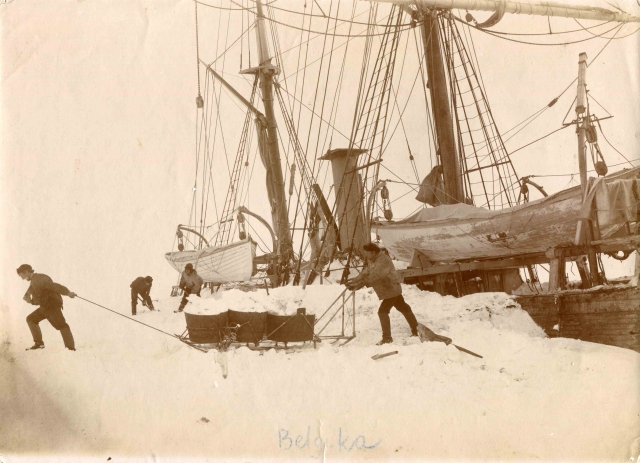
The exhibit stand mainly presents documents on the history of geology. It chronicles the origins of Earth sciences in Poland and in the world. The exhibition is complemented by attractive exhibits collected by the History of Earth Sciences and Library Section.

Before Coal was Formed

Before Coal was Formed

The exhibition presents the richness of vegetation from two of the most important carbon geologic periods in the Earth’s history: Carboniferous and Neogene. It presents reconstructions of various plant communities accomplished based upon fossils found in sediments accompanying bituminous (black) coal deposits (Carboniferous) and brown coal (lignite) (Neogene). The fossil plant specimens originate from the Upper and Lower Silesian coal deposits as well as brown coal mines in Turoszów, Konin and Bełchatów and from the site in Dobrzyń nad Wisłą town.

Our exhibition also intends to remind the visitors that coal is not only the basic energy source in Poland, but also that it is an interesting sedimentary rock of plant origin.

Amber – Poland and the World

Amber – Poland and the World

We proudly present the ninth permanent exhibition dedicated to amber in the premises of the Polish Academy of Sciences Museum of the Earth. This time, attention was paid to the distribution of amber and other fossil resins in Poland and in the world. Apart from specimens illustrating the richness of amber varieties and remarkable world of inclusions (animal and plant), we also present research interpretations on the genesis of amber and reconstruction of the amber forest. By means of raw materials from Sambia (Russia), Ukraine and Bitterfeld (Germany) as well as secondary deposits of the Baltic Sea shoreline, it has been identified where amber deposits were made at least 40 million years ago, where it can be found in Poland and why exactly there.

The section dedicated to the use of amber presents variety of its types, amber processing techniques and products related to folk medicine and traditional beliefs. A special component of the exhibition are fossil resins from all over the world (different from Baltic amber), which nowhere else in Poland – apart from the Museum of the Earth – can be admired in such diversity.

Meteorites – Stones from the Sky

Meteorites – Stones from the Sky

Meteorites have always been of particular interest. Traces of fascination with the mysterious „stones from the sky” can be found in the oldest manuscripts. Collection of meteorites presented at our exhibition was gathered by the Museum of the Earth Society before World War II. The newest specimens come from recent years. At the exhibition, Polish meteorites (including the unique collection of Pułtusk and Łowicz meteorites) deserve special attention. In addition to objects from the asteroid belt, we also present very rare meteorites originating from the Moon and Mars. The exhibition of meteorites collections gathered in the Polish Academy of Sciences Museum of the Earth creates an extraordinary opportunity to meet exceptional „guests from the space”.

Stone in Human Life

Stone in Human Life

Stone has accompanied us since the dawn of mankind. Initially, it was a material for creating simple tools. With the development of humanity, its use has changed to such extent that many ultra-modern technologies cannot be refined without mineral resources.

The exhibition presents a rich collection of rocks and minerals accompanying the everyday human life, both today and in the past. An overview of minerals with diverse application was supplemented by information on their properties, legends related to them and commonly used imitations.

From the Earth’s Geological Past

From the Earth’s Geological Past

The exhibition pertains to issues that are of interest to historical geology. It intends to explain how information concerning the Earth’s past is collected. With the use of selected examples illustrated by exhibits from often unique sites, our exhibition allows to understand the path of individual fossils and rocks to interpret the evolution of entire plant and animal groups. Moreover, it is also possible to reproduce changes of the past taking place in natural environments in the scale of regions, continents and the globe.

Processes Shaping the Earth

Processes Shaping the Earth

The exhibition on dynamic geology presents the most important phenomena and processes shaping the Earth. The purpose of the exposition is to explain processes occurring under the impact of external geological factors such as weathering, erosion, mass movement, sedimentation and processes caused by internal geological circumstance taking place in the Earth’s crust or in its interior. Our exhibition provides a synthesis outlining the effects of such processes as: diastrophism, volcanism, plutonism or metamorphism. The exhibition is illustrated with a deliberately selected collection of rock and mineral specimens.

Earth in the Solar System

Earth in the Solar System

The exhibition shows the position and peculiarity of our planet comparing to other objects in the Solar System. The space-oriented aspect of the exhibition is complemented by a section dedicated to impact craters being unique geological structures formed during collision with meteorites, comets or asteroids with the Earth’s surface The issues concerning atmosphere, biosphere, hydrosphere and lithosphere of the Earth are illustrated by satellite images and this also emphasises the outer-space extent of phenomena taking place on our planet.