📢 Informacja: 17.11.2025 – Muzeum Ziemi nieczynne

Drodzy Zwiedzający,
uprzejmie informujemy, że 17 listopada 2025 r. (poniedziałek) Muzeum Ziemi będzie nieczynne.
Przepraszamy za wszelkie niedogodności i serdecznie zapraszamy do odwiedzin w innym terminie.
This exhibition was created on the initiative of and in cooperation with the PAS Museum of the Earth in Warsaw, the PAS Institute of Paleobiology, and the Museum of Evolution of the PAS Institute of Paleobiology.
Long before Tyrannosaurus rex terrorized North America, its close kin Tarbosaurus bataar reigned supreme in Asia. These two predatory species are similar enough to one another that they were initially thought to belong to the same genus (Tyrannosaurus). Today, however, we know that Tarbosaurus was a separate genus of dinosaurs, reaching somewhat smaller sizes than Tyrannosaurus.

Like other members of the tyrannosaurid family, Tarbosaurus bataar was a bipedal predator with a large skull, a massive pelvis, and small forelimbs. The head of an adult tarbosaur measured over one meter, its body length reached up to 10 meters, and its weight could reach about 5 tons.
Numerous openings in its skull helped reduce the bone’s massive weight. Studies of its braincase indicate that the tarbosaur had an excellent sense of smell and hearing, as well as a strong ability to maintain balance and coordinate its body movements.
Marks left behind by tarbosaur teeth on the skeletons of herbivorous dinosaurs show that it preyed on large animals. The structure of their snout (a tall maxilla, massive lower jaw, and strong, curved teeth) indicates that tarbosaurs could bite with great force, tearing off chunks of flesh.
The jawbones of adult tarbosaurs often bear scars from fights, most likely with members of their own species. This behavior may have been related to establishing dominance over a given territory.
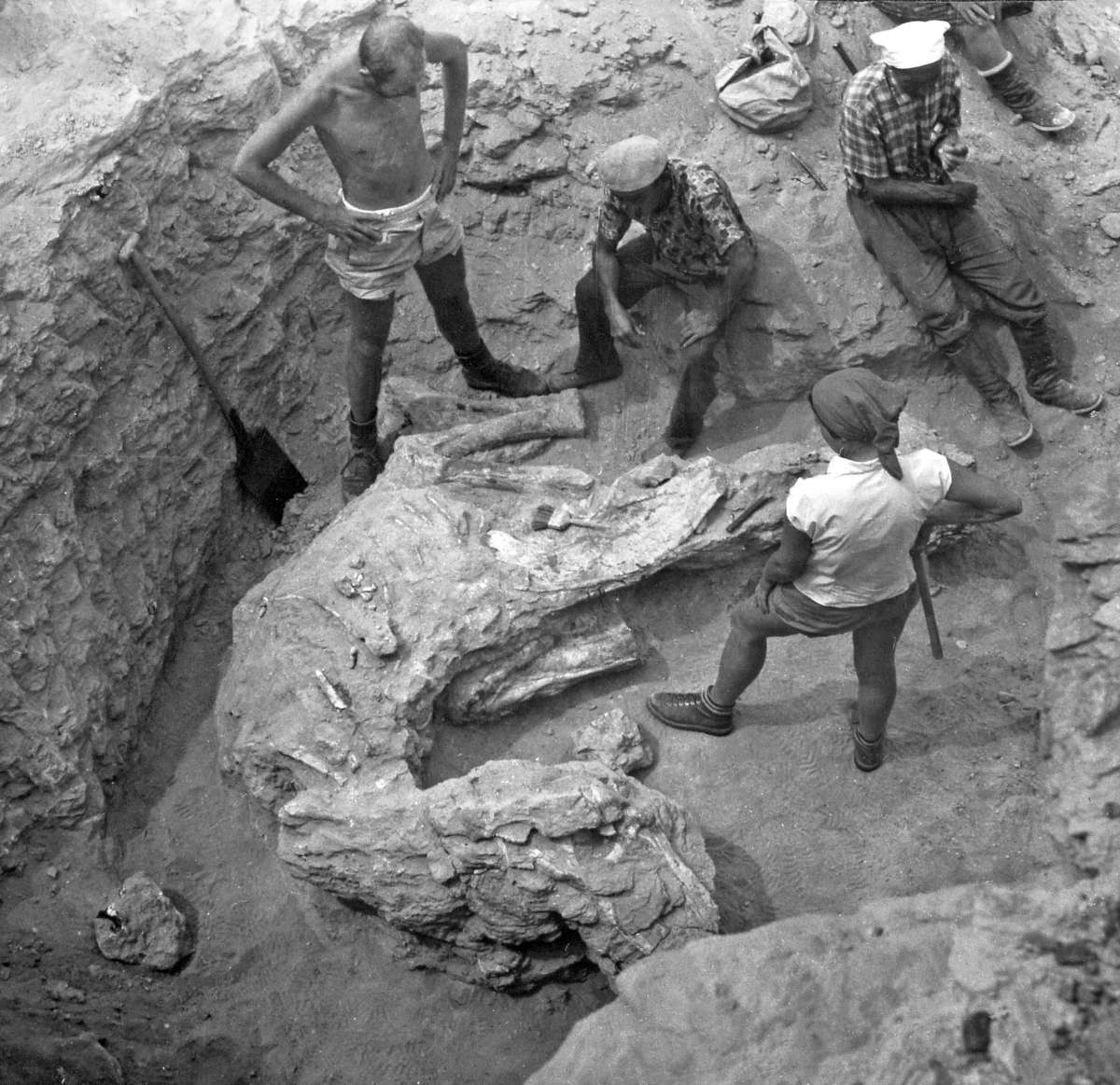
In 1964, members of the second Polish-Mongolian Paleontological Expedition decided to travel to Tsagaan Khushuu in southern Mongolia – a site with exposures of the Nemegt Formation.
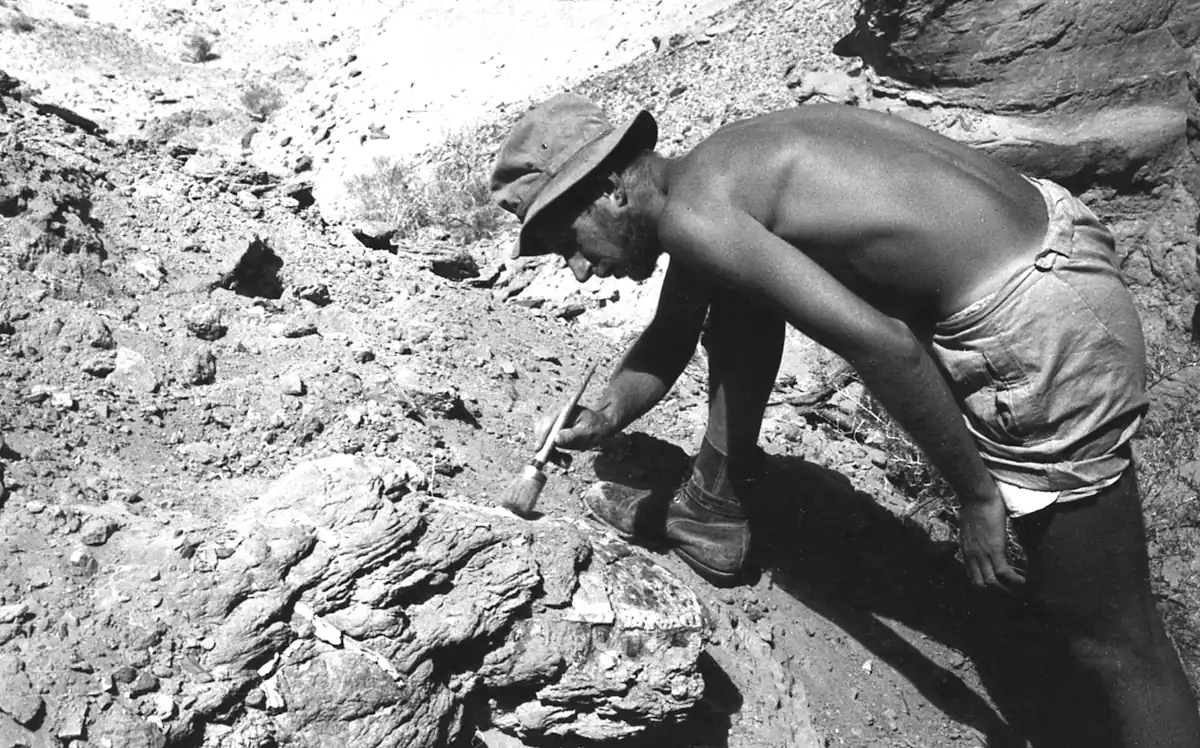
“While we were walking across the terrain at Tsagaan Khushuu, examining the exposed layers of pale and more reddish Cretaceous sandstones, Gwidon Jakubowski pointed out a spot where bones were visible in the cliff wall, about two meters below the surface. They were situated about 2.5 meters apart, and it was reasonable to assume they came from the same skeleton. […] After the first day of excavations, the nearly complete, well-preserved skull of a relatively small predatory dinosaur from the tyrannosaur group had been revealed. Presumably, as with all dinosaurs of this group found in the Gobi, it belonged to the genus Tarbosaurus. As the skeleton continued to be uncovered, the find became more and more fascinating. Within a few days, an almost complete* and remarkably well-preserved tarbosaur skeleton emerged, positioned on its side with the head arched backward, the legs tucked in, and the tail curved. […] It was relatively small in size; we estimated that it was just over 7 meters long. The skeleton had been preserved in exactly the position in which the animal died about 80 million years ago. In this same death posture – with its head thrown back and legs drawn in – we often found the bodies of camels in the desert.”
*Unfortunately, elements at the extremes of the skeleton (the tip of the snout and more than half of the tail), which protruded from the cliff wall, had weathered away and did not survive to our time.
Zofia Kielan-Jaworowska, Polowanie na dinozaury [Hunting for Dinosaurs], Wydawnictwa Geologiczne, 1969, pp. 35–36.
Articulated skeletons of extinct animals – those in which the bones remain connected at the joints – are very rare in the fossil record. For a specimen to be preserved in this way, the animal’s body must be rapidly buried by sediment shortly after death. This was most likely the case for the juvenile Tarbosaurus bataar, the apex predator of its time, whose skeleton was discovered in 1964 during the Polish-Mongolian Paleontological Expedition.
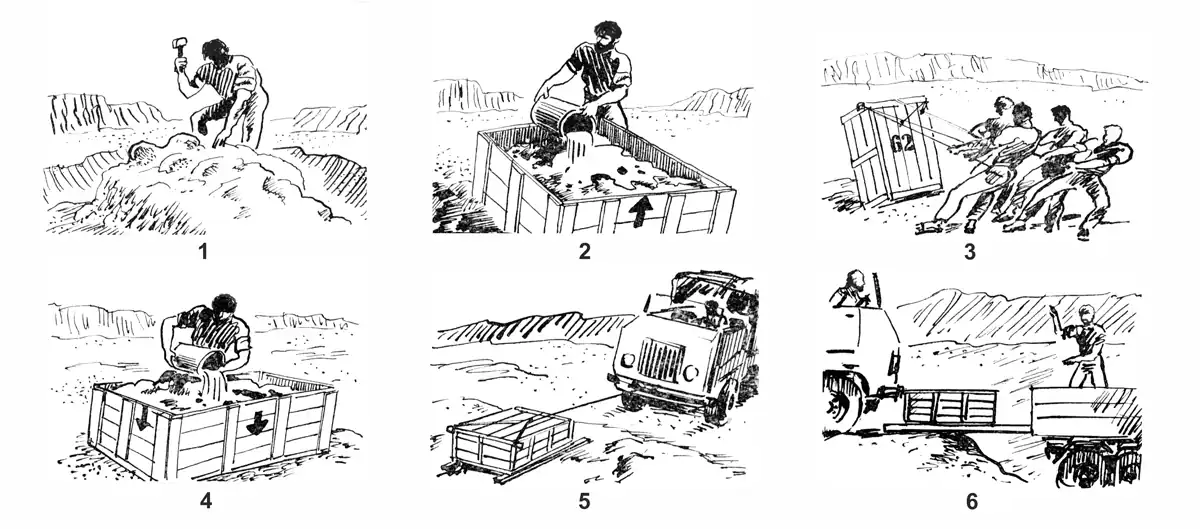
The excavated block of rock containing the skeleton was divided up into eleven parts. After they were transported to Poland and reassembled, the excess rock was removed from the specimen’s right side. A cast was then made, showing the original position in which the dinosaur was found, with the missing elements of the skull reconstructed – this cast is on display here.
After the skeleton had been prepared from the rock, it was originally reconstructed in a pose with its spine half-upright, reflecting the scientific understanding of dinosaurs in the 1970s. Today we know that this image was inaccurate. A new reconstruction, based on current knowledge, can now be seen at the Museum of Evolution of the PAS Institute of Paleobiology.

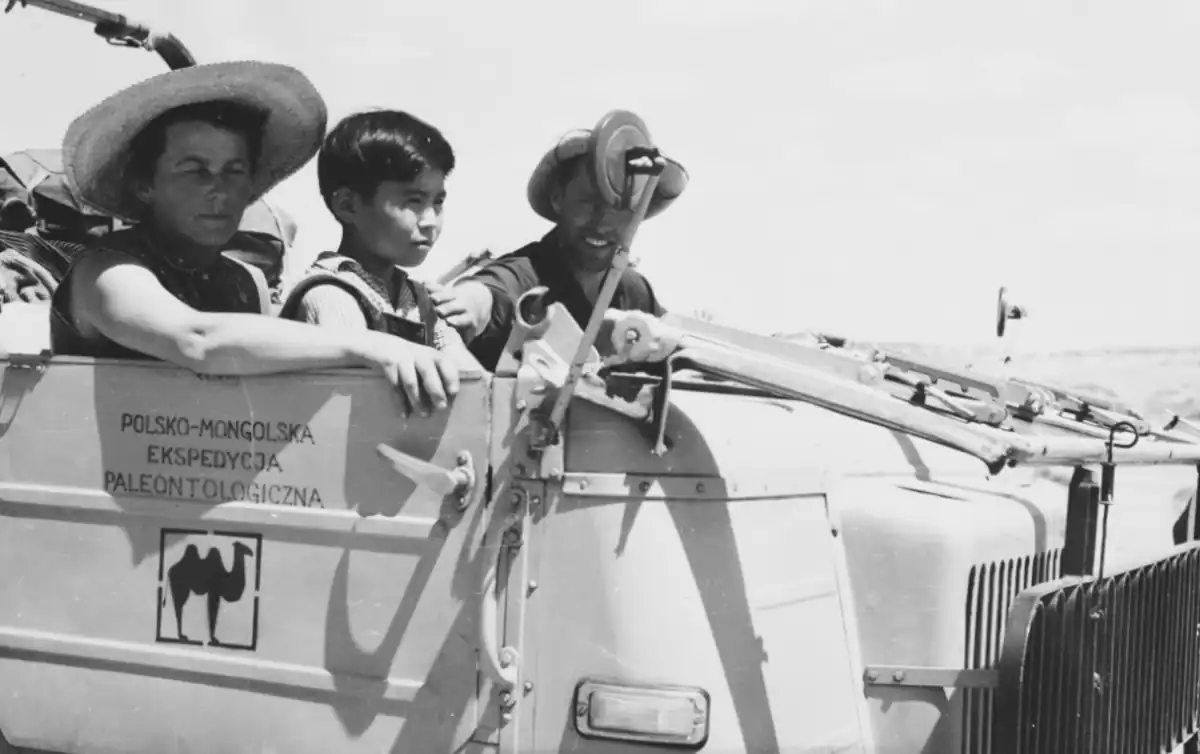
“In 1962, a delegation from the Presidium of the Polish Academy of Sciences traveled to Mongolia to sign a three-year (1963–1965) cooperation agreement.* […] I prepared a plan for organizing joint Polish-Mongolian Paleontological Expeditions to be included in the agreement, and Professor Kozłowski, a member of the delegation, took it with him. The proposal was very well received by representatives of both Academies, and after the Polish delegation returned, I was appointed by the authorities of the Polish Academy of Sciences to organize and lead these expeditions.”
*a cooperation agreement between the Polish Academy of Sciences and the then recently established Academy of Sciences of the Mongolian People’s Republic
Zofia Kielan-Jaworowska, W poszukiwaniu wczesnych ssaków [In Search of Early Mammals], University of Warsaw Press, 2013, p. 34
The first expedition, in 1963, primarily involved reconnaissance. Major field campaigns followed in 1964, 1965, 1970, and 1971, when large-scale excavations were carried out in the Gobi Desert and western Mongolia. In addition, three smaller expeditions took place in 1967, 1968, and 1969. These did not involve excavations but focused instead on surface collecting, yielding fossils – mainly mammals and lizards – from the Cretaceous rocks at Bayan Zag.
The Polish-Mongolian Paleontological Expeditions to Mongolia (1963–1971) were recognized worldwide as among the most important paleontological undertakings of their time. They yielded not only impressive dinosaur skeletons but also fossils of birds, mammals, turtles, crocodiles, lizards, snakes, invertebrates, and plants.
At the time the project ended, the collection of Late Cretaceous mammals gathered during the expeditions represented the world’s largest assemblage of Mesozoic mammal skulls housed at any scientific institution.
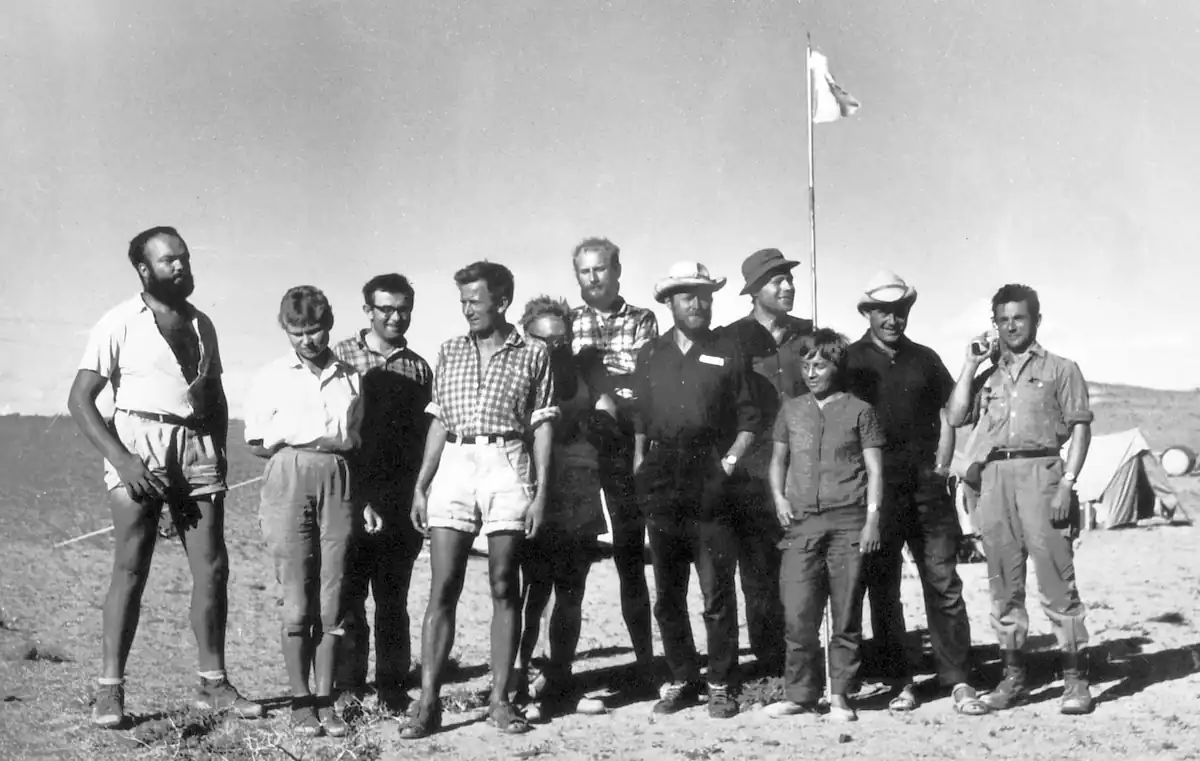
The original plan for the expeditions envisioned that Professor Zofia Kielan-Jaworowska would assume overall organizational and scientific leadership, while Associate Professor Julian Kulczycki, then head of the Department of Paleozoology at the Museum of the Earth of the Polish Academy of Sciences in Warsaw, would lead the fieldwork. In 1963, he directed a five-person reconnaissance expedition that identified sites for future excavations. Kulczycki was also meant to lead the 1964 expedition, but for health reasons he was replaced by Professor Kazimierz Kowalski of Kraków.
Among the staff of the Department of Paleozoology of the Museum of the Earth, Polish Academy of Sciences in Warsaw, participants in the expeditions included Teresa Maryańska and Gwidon Jakubowski.
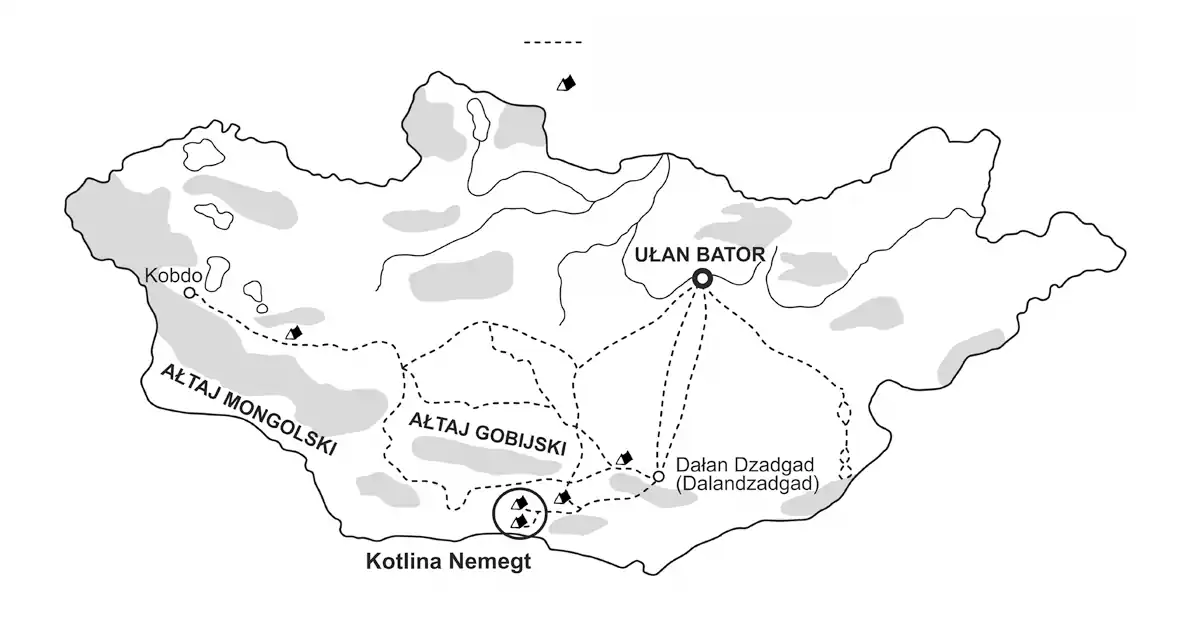
Paleontological excavations in the Gobi Desert of Mongolia have been carried out almost continuously since 1922. Complete dinosaur skeletons are still being unearthed there, often even including skin impressions, making them among the best-preserved in the world. The Gobi remains a site of enormous research potential that continues to attract scientists from across the globe.
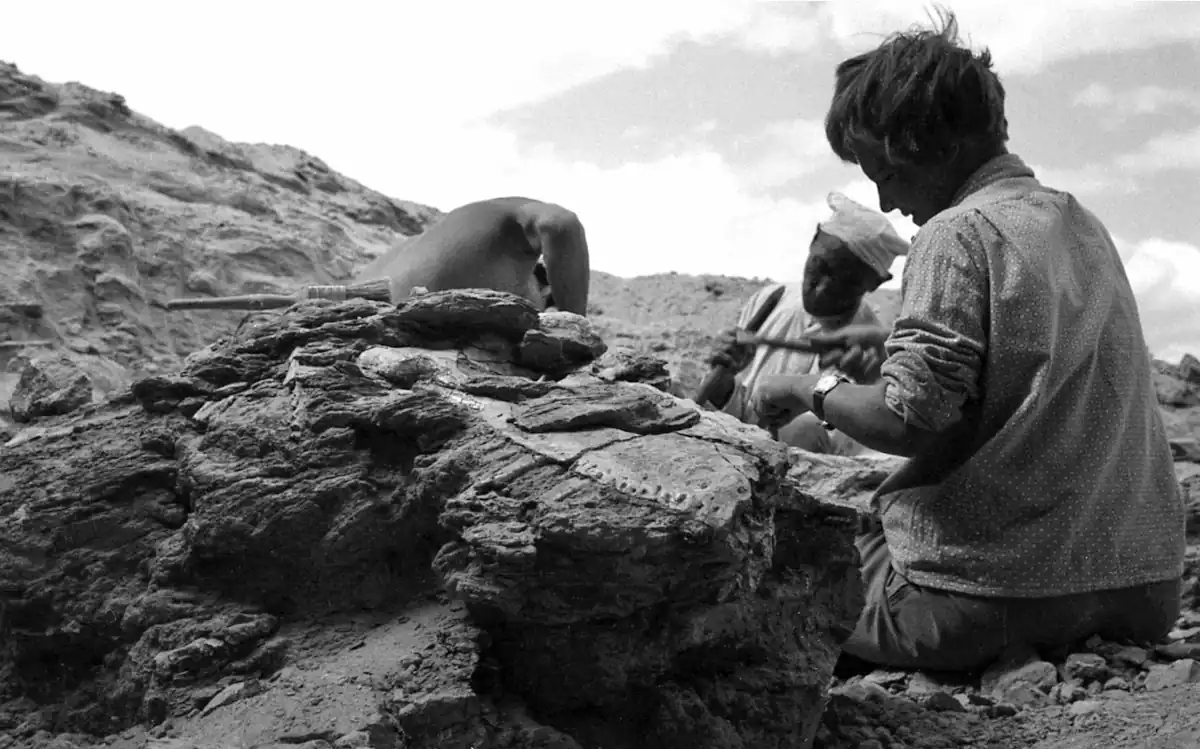
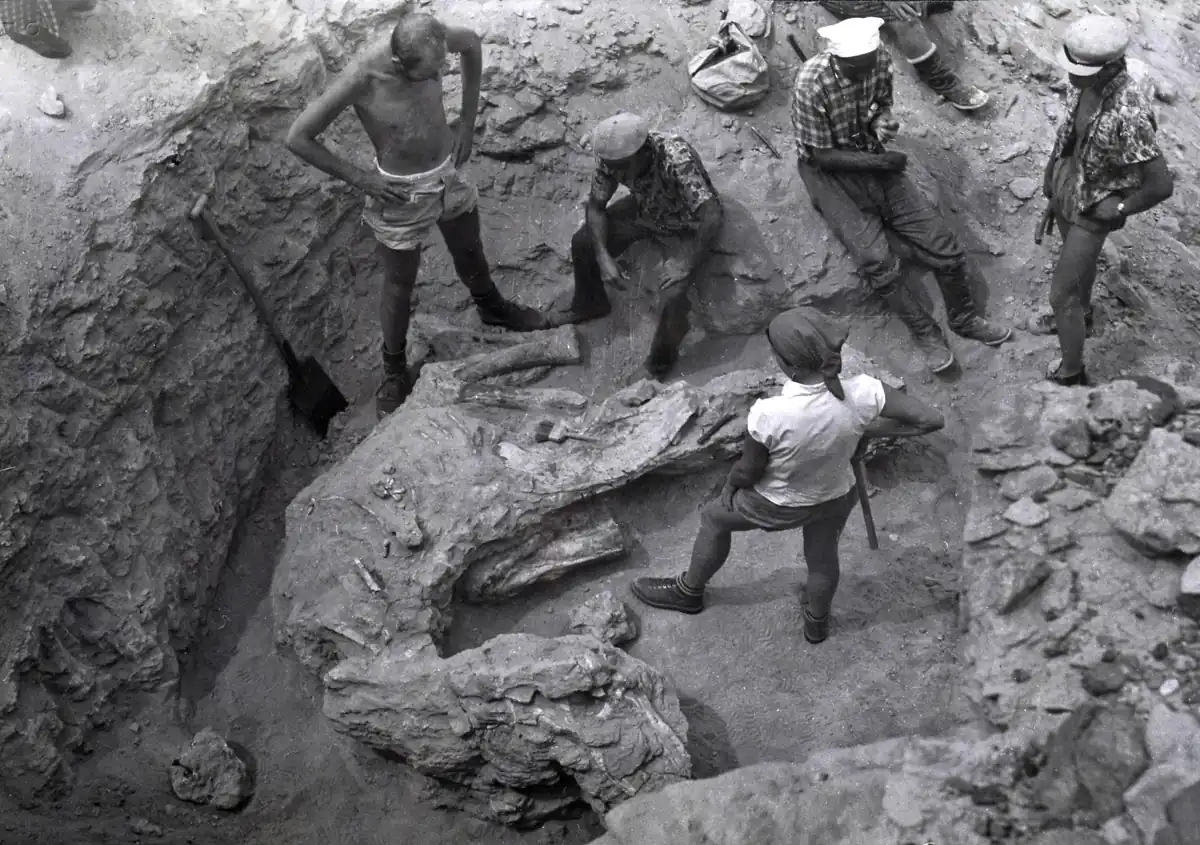
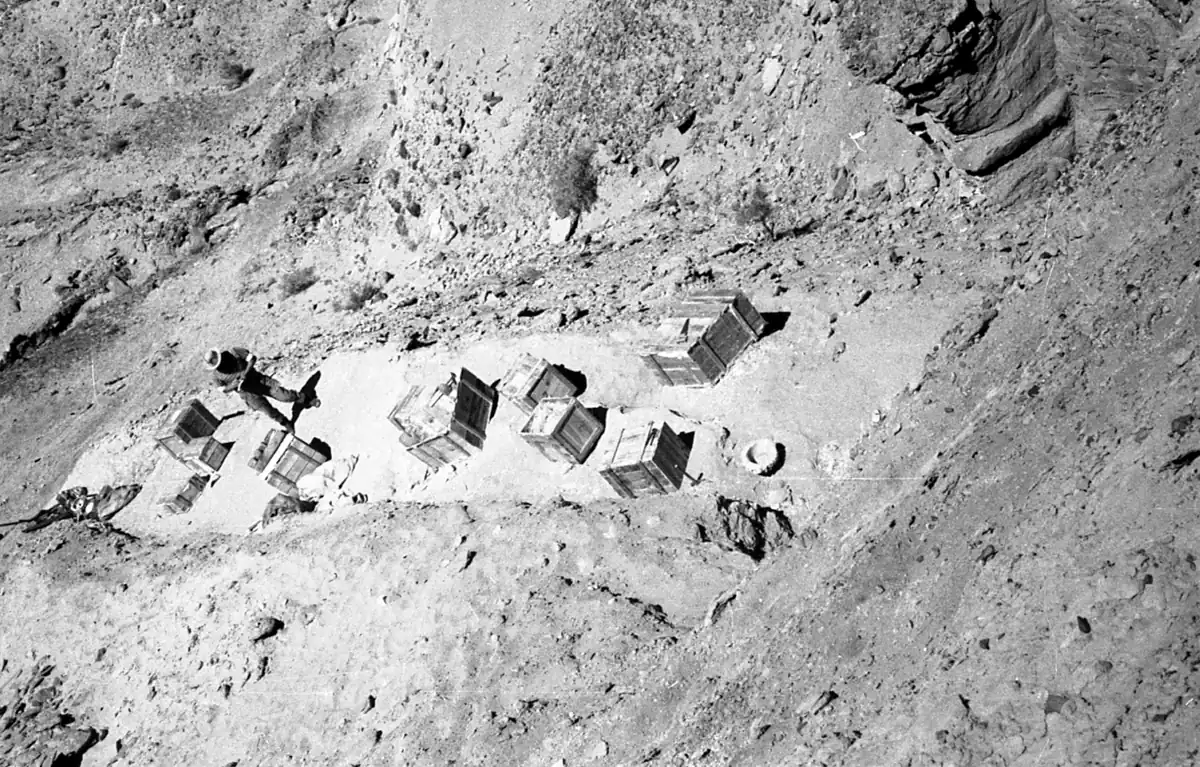
The photographs presented here come from the archives of the PAS Museum of the Earth and the Paleontological Collection of the PAS Institute of Paleobiology
Uprzejmie informujemy, że w dniach 7 i 8 czerwca 2025 r.
Muzeum Ziemi w Warszawie będzie nieczynne.

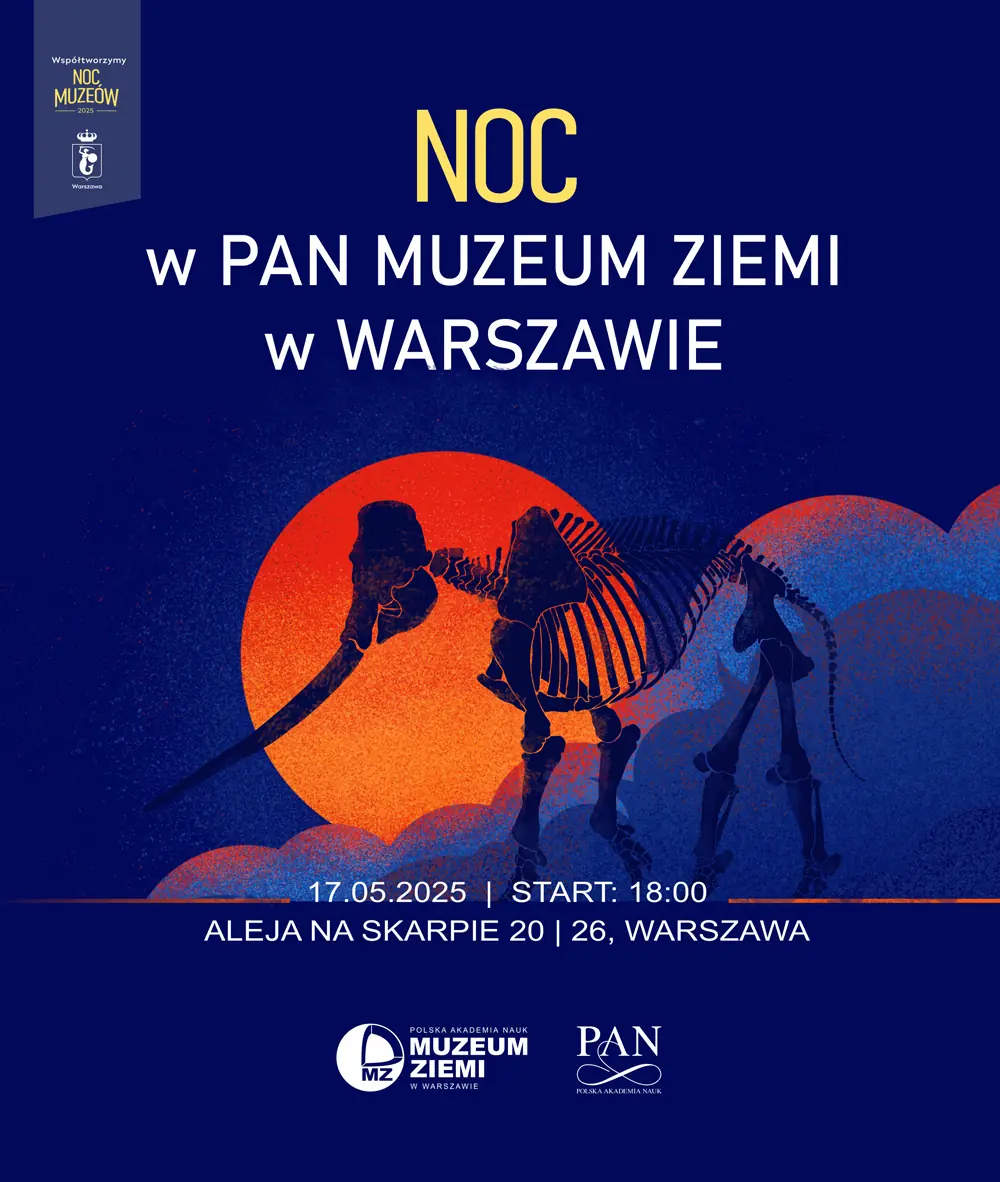
📅 Sobota, 17 maja 2025
📍 al. Na Skarpie 20/26 i 27, Warszawa
🕕 Start: godz. 18:00
🎟 Wstęp wolny!
Zapraszamy serdecznie do PAN Muzeum Ziemi w Warszawie, które na tę wyjątkową noc przygotowało mnóstwo fascynujących atrakcji!
 PROGRAM WYDARZEŃ:
 18:00 Wernisaż wystawy „Archeologia Antropocenu” – artystyczno-naukowa refleksja nad wpływem człowieka na naszą planetę.
 18:30 Panel dyskusyjny „Archeologia Antropocenu” z udziałem – dr Moniki Stobieckiej oraz dr hab. Błażeja Błażejowskiego, prof. PAN.
 20:00 Wykład dr. Gwidona Jakubowskiego „60 lat w Muzeum Ziemi” – pasjonujące opowieści o poszukiwaniu dinozaurów na pustyni Gobi oraz tajnikach pracy paleontologa.
 21:00 Wykład dr. Michała Czernielewskiego o lodowcach, zmianach klimatycznych oraz roli CO₂ w geologicznej historii Ziemi.
 PRZEZ CAŁY WIECZÓR:
 Muzealna gra „Znajdź eksponat”
Zwiedzanie wystaw stałych
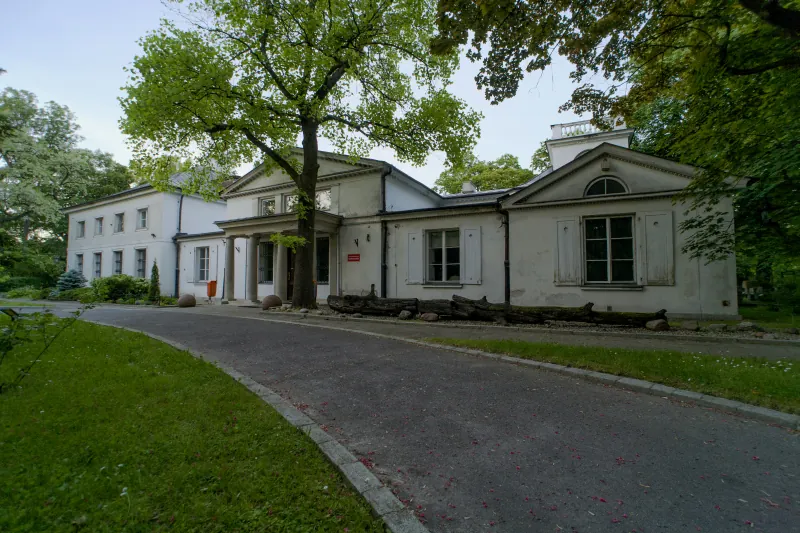
Zwiedzanie „Willi Pniewskiego”
Wystawa czasowa Ewa Miazek „Miejsca Wykreowane”
Do zobaczenia! 

Roślinność neogenu
Kenozoik, ostatnia era w dziejach Ziemi, rozpoczął się 66 milionów lat temu. Po gorącym paleogenie, klimat neogenu stopniowo się ochładzał i osuszał. W miocenie był jeszcze bardzo ciepły i wilgotny, dzięki czemu na lądach dominowały bujne lasy. Natomiast pod koniec pliocenu klimat zaczął przypominać ten, jaki mamy obecnie, do tego we wnętrzach kontynentów znacznie się osuszył, przez co rozwinęły się tam rozległe bezdrzewne formacje roślinne.
Klimat miocenu, a także ukształtowanie geograficzne Europy Środkowej i Polski w tym czasie sprzyjały rozwojowi rozległych bagien, których pozostałościami są bogate złoża węgli brunatnych oraz bardzo liczne skamieniałości roślin.
W neogenie roślinność leśna Europy nie przypominała dzisiejszej, składem i strukturą bliższa była tej, znanej współcześnie z obszarów Ameryki Północnej i Azji Wschodniej. Na początku miocenu w lasach Europy Środkowej bardzo duży udział, czasem dominujący, miały drzewa wiecznie zielone, a miejscami dość częste były palmy. Jednak, pod koniec miocenu i w pliocenie, w wyniku postępującego ochłodzenia klimatu były stopniowo wypierane przez gubiące liście rośliny klimatu umiarkowanego. Nie spowodowało to jednak drastycznego zubożenia lasów Europy, a jedynie zmianę ich składu. W miocenie występowało jeszcze wiele rodzajów roślin wymarłych i takich, które współcześnie nie występują już w Europie – do początków plejstocenu większość z nich wymarła lub schroniła się na południu, w tak zwanych ostojach.
Szczątki roślin znajdowane podczas wydobycia węgla brunatnego świadczą o bogactwie i odmienności ówczesnej roślinności bagiennej. Tak jak współcześnie, roślinność ta różnicowała się, tworząc tak zwane zbiorowiska, a różne ich typy tworzyły się w zależności od rodzaju podłoża i jego wilgotności. W najbardziej podmokłych środowiskach rozwijały się szuwary, w pośrednich występowały lasy bagienne i zbiorowiska krzewiaste, a najmniej podmokłe środowiska zasiedlały lasy łęgowe.
Neogene Vegetation
The Cenozoic, the most recent era in the Earth’s history, began 66 million years ago. After the warm Paleogene, the Neogene climate gradually cooled and dried. During the Miocene, the climate remained very warm and humid, allowing lush forests to dominate the land. By the end of the Pliocene, however, the climate had begun to resemble the one we know today, becoming significantly drier in the continental interiors, where vast, treeless plant formations emerged.
The warm Miocene climate, along with the geography of Central Europe and Poland at that time, supported extensive swamps, remnants of which are preserved today in rich lignite deposits and numerous plant fossils.
The Neogene forests in Europe were quite different from today’s. In composition and structure, they were more like modern forests in North America and East Asia. The early Miocene forests in Central Europe were often dominated by evergreen trees, with palms being fairly common in some areas. However, at the end of Miocene and in Pliocene, the climate cooled and evergreen trees were gradually replaced by deciduous plants typical of temperate regions. This change did not lead to a dramatic loss of plant diversity in European forests, but rather to a shift in their composition. The Miocene still hosted many now-extinct plant genera and species no longer found in Europe; by the early Pleistocene, most of these had either gone extinct or retreated to southern havens known as refugia.
Plant remains found during lignite exploitation reveal the diversity and unique nature of swamp vegetation from that period. Much like today, this vegetation was highly specialized, forming distinct plant communities that varied based on soil type and moisture. In the wettest environments, reed beds thrived; swamp forests and shrub communities grew in intermediate areas, while riparian forests developed in the drier wetlands.
Roślinność karbonu
Karbon, przedostatni okres ery paleozoicznej, który rozpoczął się 359 milionów lat temu, jest uznawany za jeden z przełomowych okresów w historii świata roślin. W tym czasie nastąpił szczyt rozwoju wielu grup roślin lądowych, które tworzyły pierwsze formacje leśne na Ziemi o tak dużej złożoności.
Obszary dzisiejszych europejskich zagłębi węglowych były w karbonie nizinnymi terenami bagiennymi i lagunowymi, porośniętymi bujnymi, różnorodnymi lasami tropikalnymi, bogatymi w formy i gatunki. W ich skład wchodziły drzewiaste rośliny zarodnikowe spokrewnione z dzisiejszymi widłakami i paprociami, a także wymarłe pierwotne rośliny nagozalążkowe, takie jak paprocie nasienne, kordaity i pierwsze szpilkowe. Z tych roślin powstały karbońskie węgle kamienne wydobywane dziś w Polsce.
We wczesnym karbonie roślinność wykazywała jeszcze niewielkie zróżnicowanie geograficzne, była dość jednolita na całej kuli ziemskiej.
Natomiast w późnym karbonie pojawiły się już wyraźne różnice w składzie szaty roślinnej w zależności od położenia na kuli ziemskiej. Ukształtowały się odmienne w swoim charakterze prowincje roślinne, których wyodrębnienie związane było z pogłębianiem się różnic klimatycznych. Na półkuli północnej ukształtowały się: prowincja euramerykańska (kontynent Euramerykański), syberyjska i chińska (kontynent Angary i Katazji), a na półkuli południowej – gondwańska (kontynent Gondwany).
Europa wraz ze wschodnią częścią Ameryki Północnej, północną częścią Afryki, Bliskim Wschodem oraz obszarem aralokaspijskim wchodziła w skład prowincji euroamerykańskiej. Karbońska flora tych obszarów należy do najlepiej poznanych. Ponieważ większa część tej prowincji leżała w strefie okołorównikowej, jej klimat był zapewne najbardziej zbliżony do dzisiejszego tropikalnego, o wysokiej temperaturze i wilgotności. Tereny europejskich zagłębi węglowych były w karbonie nizinnymi obszarami bagiennymi i lagunowymi, porośniętymi bujnymi, obfitującymi w formy i gatunki swoistymi lasami. W ich skład wchodziły drzewiaste rośliny zarodnikowe: widłakowe, paprociowe, a także pierwotne rośliny nagozalążkowe – paprocie nasienne i kordaity. W runie lasów występowały paprocie zielne, drobne widłaki i skrzypy, mchy i wątrobowce. Liczne były niezwykłe, pnące paprocie i klinolisty (pnące skrzypy). Na obrzeżach bagien rosły nagozalążkowe – kordaity, a na wzniesieniach nieliczne jeszcze pierwotne iglaste. Rośliny te nie występowały przypadkowo, bezładnie wymieszane ze sobą, lecz podobnie jak współczesna roślinność miały określone preferencje co do klimatu, ilości wody i słońca i w zależności od tych warunków tworzyły skupiska o określonym składzie gatunkowym.
Carboniferous Vegetation
The Carboniferous period (the second-to-last period of the Paleozoic era) began 359 million years ago and is considered one of the pivotal times in plant history. During this period, many groups of land plants reached their peak development, forming the Earth’s very first highly complex forest ecosystems.
The areas that are now Europe’s coal basins were – back in the Carboniferous – low-lying swamps and lagoons covered in lush, diverse tropical forests rich in different species. These forests included tree-like, spore-bearing plants related to today’s lycophytes and ferns, as well as extinct primitive gymnosperms called seed ferns, cordaites, and earliest conifers. It is these plants ultimately formed the bituminous coal deposits that are now mined in Poland and elsewhere.
In the early Carboniferous, plant life showed limited geographical variation and was fairly uniform across the globe. However, in the late Carboniferous, distinct differences in plant communities began to emerge based on geography, with unique plant provinces forming as climate differences grew more pronounced. The Euramerican province (on what was then the Euramerican continent), the Siberian province, and the Chinese province (on what were then the continents of Angara and Cathaysia) formed in the northern hemisphere, while the southern hemisphere saw the emergence of the Gondwanan province (on the continent of Gondwana).
Europe, along with eastern North America, northern Africa, the Middle East, and the Aral-Caspian region, was then part of the Euramerican province. The Carboniferous flora of this province is among the best understood. Since much of the province lay in an equatorial zone, its climate was likely similar to today’s tropical climates, with high temperature and humidity. The European coal basins of the Carboniferous period were low-lying swamp and lagoon areas covered by dense, species-rich forests. These forests included tree-like spore plants such as lycophytes and ferns, along with primitive gymnosperms like seed ferns and cordaites. The lower layer of the forest featured herbaceous ferns, small lycophytes, horsetails, mosses, and liverworts, along with various climbing ferns and calamites. Gymnosperms like cordaites grew along the swamp edges, with a few primitive conifers appearing on higher ground. These plants did not grow haphazardly mixed together; rather, like modern plants, they had specific preferences for climate, water, and sunlight, forming distinct clusters based on these conditions.
Wprowadzenie
Wykorzystanie surowców energetycznych to jeden z głównych tematów polityczno-gospodarczych ostatnich lat. Złoża węgla nie są jednak tylko źródłem energii – dla paleobotaników stanowią one niewyczerpaną skarbnicę wiedzy o roślinach z przeszłości geologicznej. Przed powstaniem węgla musiała bowiem istnieć roślinność, będąca źródłem materii organicznej. Jej pozostałościami są prezentowane skamieniałości.
Energia docierająca do Ziemi ze Słońca jest przekształcana przez rośliny do podtrzymania własnych procesów życiowych, w tym także do budowania tkanek. Szczególnie intensywnie proces ten zachodzi u roślin lądowych. Obumarłe tkanki są w większości szybko rozkładane przez zwierzęta, grzyby i bakterie. W trakcie rozkładu dochodzi do uwolnienia energii zgromadzonej w komórkach. Najwydajniej proces ten zachodzi na powierzchni ziemi, przy swobodnym dostępie tlenu. Ubocznym produktem przemiany materii w energię są proste, łatwo przyswajalne związki mineralne, które mogą być na powrót użyte przez organizmy żywe. Mimo dużej wydajności procesu rozkładu, znaczna część tkanek roślinnych może pozostać nierozłożona. Dzieje się tak wtedy, gdy zostają zbyt szybko przetransportowane z powierzchni ziemi i pogrzebane w miejscach pozbawionych dostępu tlenu. Nagromadzona w takich miejscach materia roślinna może pozostawać nierozłożona przez bardzo długi czas, ulegając jedynie powolnym przemianom, by w ostateczności przeobrazić się w węgiel.
Proces tworzenia się węgla przebiega w dwóch etapach. W pierwszym – z nagromadzeń szczątków roślinnych w warunkach beztlenowych i przy udziale bakterii, grzybów i bezkręgowców powstaje torf. W trakcie tworzenia torfu dochodzi do rozkładu najmniej trwałych substancji budujących tkanki roślinne. Torf jest zbudowany z prawie niezmienionych organów roślinnych, zawiera jedynie nieco ponad 50% pierwiastkowego węgla. Aby nastąpił drugi etap, torf musi zostać przykryty nieorganicznymi osadami. W wyniku nacisku, jaki wywierają te osady, torf ulega ubiciu i odwodnieniu, a tworzące go szczątki roślinne ulegają znacznemu przeobrażeniu, w wyniku czego powstaje węgiel brunatny. Zawiera on do 75 % pierwiastka węgla. Im głębiej węgiel brunatny znajduje się pod powierzchnią ziemi, tym podlega wyższym ciśnieniu i temperaturze i szybciej przebiega jego dalsze przeobrażanie. Końcowym efektem tych przemian jest węgiel kamienny zawierający od 75 do 97% pierwiastka węgla.
Badając węgiel i osady mu towarzyszące, można ustalić, z jakich roślin powstał węgiel i w jakich warunkach klimatu i środowiska rośliny te występowały.
Introduction
The consumption of fossil fuels has become a major political and economic issue in recent years. However, coal deposits are more than just an energy source – for paleobotanists, they are an invaluable treasure-trove of information about ancient plants from the geological past. For coal to be able to form, there first had to be plant life as a source of organic matter. The fossils on display are remnants of this prehistoric vegetation.
The energy that reaches the Earth from the Sun is captured by plants and transformed to sustain their life processes, including tissue-building. This is especially intensive in terrestrial plants. Most dead plant matter gets quickly decomposed by animals, fungi, and bacteria, releasing the energy stored within the cells. This process is most efficient on the Earth’s surface, where oxygen is freely available. As this organic matter is transformed back into energy, simple, easily absorbed mineral compounds get left behind, which can be reused by living organisms. Although decomposition is generally quite efficient, when plant tissue gets rapidly buried in oxygen-poor (anaerobic) locations, a substantial portion may remain intact. In such places, plant material can remain undecomposed for a long time, undergoing slow transformations that eventually lead to the formation of coal.
In fact, the formation of coal plays out in two stages. In the first, plant remains accumulate in anaerobic conditions, and under influence of bacteria, fungi, and invertebrates transform into peat. During this process, the less stable substances in the plant tissues break down. Peat consists of nearly intact plant material, contains just over 50% carbon. For the second stage of coal-formation to occur, peat has to get buried under layers of inorganic sediment. Due to the pressure exerted by these sediments, the peat becomes compacted and dehydrated, with its plant material undergoing significant changes to form brown coal, which contains up to 75 % elemental carbon The deeper the brown coal comes to lie beneath the Earth’s surface, the more pressure and heat it experiences, accelerating its transformation. The final product of this process is bituminous coal, which contains 75 to 97% elemental carbon.
By studying coal and the surrounding sediments, we can determine the types of plants that contributed to the coal’s formation and learn about the climate and environmental conditions in which these plants once thrived.
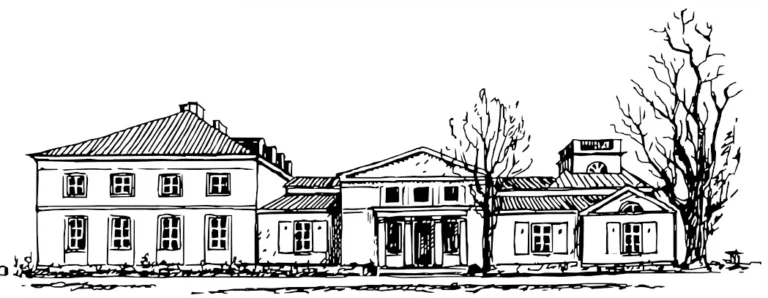
Miejsce pracy: Aleja Na Skarpie 20/26 i 27, 00-488 Warszawa
Przewidywany termin zatrudnienia: od zaraz
Podstawa zatrudnienia: umowa o pracę
Wymiar czasu pracy: pełen etat
Wymagane dokumenty i oświadczenia:
Prosimy o zamieszczenie dodatkowej klauzuli o treści:
„ Wyrażam zgodę na przetwarzanie przez Polską Akademię Nauk Muzeum Ziemi w Warszawie moich danych osobowych zawartych w dokumentach aplikacyjnych na potrzeby przeprowadzenia postępowania rekrutacyjnego na stanowisko opiekuna ekspozycji muzealnych”
Zgłoszenia z klauzulą należy przesyłać do dnia 9 maja 2025 roku drogą elektroniczną z tytułem maila „rekrutacja – opiekun ekspozycji muzealnych” na adres: sekretariat@mz.pan.pl
PAN Muzeum Ziemi w Warszawie zastrzega sobie prawo do kontaktu tylko z wybranymi kandydatami.
Zastrzegamy sobie również prawo do wcześniejszego zakończenia procesu rekrutacji w przypadku wyłonienia kandydata przed terminem ważności ogłoszenia.
Drodzy Zwiedzający,
informujemy, że w dniu 14 marca (piątek) wystawy: „Kamień w życiu człowieka”, „Meteoryty – kamienie z nieba” oraz „Bursztyn Polska i Świat” będą niedostępne dla publiczności.
W tym dniu wstęp na pozostałe nasze wystawy będzie bezpłatny.
Serdecznie przepraszamy za niedogodności.

⭐Niech czas Bożego Narodzenia będzie pełen ciepła, radości i wytchnienia od codziennego pędu.
Zdrowych i pogodnych Świąt Bożego Narodzenia oraz wszelkiej pomyślności w Nowym Roku
życzy zespół PAN MUZEUM ZIEMI W WARSZAWIE
❤️Dziękujemy, że jesteście z nami!